
Three Numbers In Your Bag You Should Know, But Don't
- matt25637
- 2 days ago
- 4 min read

Here's a question that should bother you more than it does.
How far do you hit your 7-iron?
You probably have a number ready. Most golfers do. It's almost always the longest 7-iron you've ever hit, lightly rounded down so it sounds humble. The number you'd say at the bar. The number you tell your buddies in the cart. The number you punch into your GPS app when it asks.
It's also the number that loses you the most strokes in your golf life. By a wide margin.
The truth, and Trackman will show you this in about ninety seconds, is that you don't hit your 7-iron one distance. You hit it a distribution. A bell curve. Some flush, some fat, some thin, some pured into the breeze. The shot you actually face on the course is a random sample from that curve. The number you tell your buddies is the right tail. The bar number. And every time you club for the bar number, you're betting your scorecard against the math.
The best players in the world don't think this way. They think in three numbers. Not one.

NUMBER | 01
Your Dispersion Width
From Side Carry Consistency → Full 4σ Spread (95%)
This is the one nobody thinks about, and the one that decides almost every aim point you'll ever pick.
Open Trackman. Hit your 7-iron twenty times. Look at the column called Side Carry Consistency. That number, in yards, is one standard deviation of how far left or right of your target you're landing. Most amateurs find an 8 in there and shrug. They shouldn't.
Because here's what an 8 actually means. It means your true shot pattern, the one that catches roughly 95% of your 7-irons, is 32 yards wide. Sixteen yards left of your aim point. Sixteen yards right. Multiply your Side Carry Consistency by four. That's your real corridor. That's the size of the window you're working with whether you want to acknowledge it or not.
Now look at the next flag you're tempted to fire at. Is there sixteen yards of green to the left of it? Is there sixteen yards of safe ground to the right? If the answer is no, congratulations, you just discovered why aiming at flags is the most expensive habit in amateur golf. Tiger picked the middle of the 12th green at Augusta for exactly this reason. He wasn't being timid. He was being correct. The flag was tucked four paces from the water. His corridor wasn't.


Ready to try the Noonan AI Caddie App?
NUMBER | 02
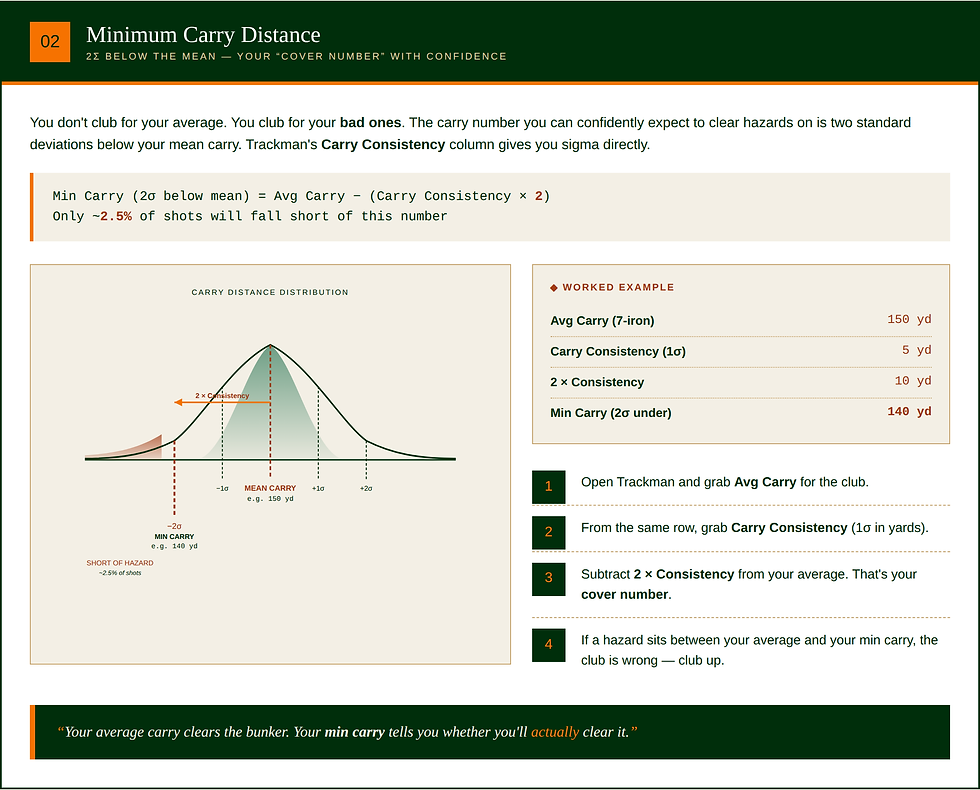
The Cover Number
2σ Below the Mean — Min Carry With Confidence
This is the one Tiger trusted on 12.
You don't club for your average carry. You club for your bad ones. The carry distance you can confidently expect to clear a hazard with isn't your mean, it's the number two standard deviations below your mean. That's your cover number. Roughly 97.5% of your shots will fly at least that far in the air. The other 2.5% are the ones you don't want to think about, but those are the ones that find the water.
For the average 7-iron golfer, the cover number lives about 8 to 12 yards short of the average. The gap gets wider the longer the club. And it's almost never the number you punch into your GPS app, because the GPS app doesn't know your cover number. It only knows the bar number.
Augusta's 12th plays roughly 155 yards. Molinari hit a club he "usually" hits 158. He didn't miss it. He hit it exactly how he wanted to, by his own admission afterward. He just hit it three yards short of his usual, which is what golf shots do, because that's what bell curves are for. Tiger took one more club. His cover number was on the green. Their cover numbers were in the creek. The math was identical for both of them. Only one of them respected it.

NUMBER | 03
The Hot One
2σ Above the Mean — The Drive That Runs Through Trouble
Every golfer has a hot one in them. The drive you flush downwind on a baked-out fairway. The 5-iron that catches a downslope and won't quit. The shot you brag about in the clubhouse and absolutely should not have hit, because there was a fairway bunker 285 yards out that you'd never thought about.
Your hot one isn't an outlier. It's the other end of the same bell curve. Take your average total distance, add two standard deviations of your Total Consistency, and you've got the line that 97.5% of your shots stay short of. Anything past it is the rare hot one. Anything you're aiming at past it is a coin flip with the trouble behind it.
Long is almost always worse than short. Short-side bunkers, sloped fall-offs, pin-high pitch shots from impossible angles, three-putts from the back fringe. The 12th green at Augusta is a perfect example in reverse. Anything past the green dies in a bunker on a downslope and from there even Tiger isn't getting up and down. So Tiger picked a club whose hot one stayed on the dance floor. Not the club whose average might.
Once you know your hot one, you stop hitting driver on holes where driver only helps when you mishit it. You stop trying to reach par 5s in two when "in two" requires the 99th-percentile outcome to clear the front bunker. You start picking clubs that win you the hole on the median outcome, not the dream one.


Comments